gcse persian a level persian

About this guide: This guide is written by educators specialising in GCSE and A-Level Persian exam preparation.

GCSE Farsi (Persian) & A-Level Persian: The Complete Guide for Students and Parents (Edexcel)

Searching for GCSE Farsi, GCSE Persian, A Level Farsi, or A Level Persian can be surprisingly confusing. Some pages sound like a school brochure, others are too vague, and most don’t answer the practical questions families actually have: What is GCSE Persian? Is it “easy” for native speakers? What does Edexcel test? How is A-Level Persian different? And does either one help with university applications?

This guide is written for parents and students who want clear, accurate information about GCSE Persian (Farsi) and A-Level Persian—especially within the UK system and the Pearson Edexcel exam board. You’ll learn the exam structure, what high grades really require, common pitfalls, and a realistic preparation plan.


What Is GCSE Persian (Farsi)?

GCSE (General Certificate of Secondary Education) is a UK qualification typically taken by students aged 14–16 (usually in Years 10–11). GCSE Persian (often searched as GCSE Farsi) is offered as an official language GCSE through specific exam boards—most commonly Pearson Edexcel.

Like other GCSE subjects, GCSE Persian contributes to a student’s overall GCSE profile and can be included in school reporting and (where relevant) post-16 pathways. Many heritage speakers choose it because it can be a strong subject in the GCSE mix—but only if it’s prepared properly.

Who Is GCSE Persian Suitable For?

  • Heritage / native speakers (students who speak Persian at home)
  • Non-native learners (students who learned Persian as a second/third language)
  • Home-educated (private candidates) taking the exam via an approved centre
  • International students who want a formal UK-recognised qualification

Is GCSE Persian Easy or Difficult?

The honest answer: GCSE Persian can feel easy at the speaking level for many heritage students, but high grades are not automatic. The exam rewards accuracy, structure, and formal writing skills—areas where many fluent speakers are least practised.

GCSE Persian for Native Speakers: The Hidden Risks

Many heritage speakers are comfortable in conversation but lose marks because they:

  • write in informal / spoken Persian instead of an exam-appropriate register
  • make frequent spelling and orthography mistakes
  • lack paragraph structure and clear argument flow in writing tasks
  • translate “word-by-word” rather than producing natural, accurate English/Persian

In practice, this is the difference between a mid/high grade and a top grade: fluency helps, but exam technique is what turns fluency into a Grade 9.

GCSE Persian for Non-Native Speakers: When It Works

For non-native learners, GCSE Persian is absolutely achievable if preparation focuses on:

  • high-frequency vocabulary and exam themes
  • structured speaking answers (not just “chatting”)
  • reading strategies for unfamiliar words
  • consistent writing practice with feedback

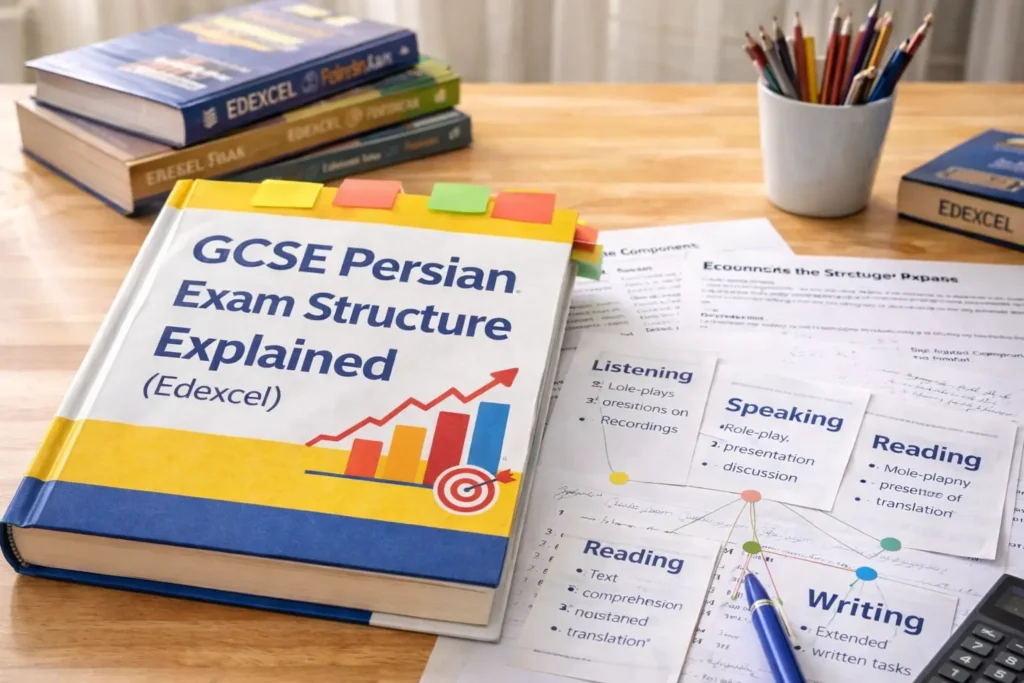
GCSE Persian (Farsi) Exam Structure: Pearson Edexcel

GCSE Persian (Edexcel) assesses four skills. Each skill typically accounts for 25% of the final grade. (Exact paper codes and timings can vary by specification year, but the skills and weighting are consistent.)

1) Listening (25%)

Listening tests your ability to understand spoken Persian across familiar topics. Students often struggle when speech is faster than classroom pace, or when they miss key details (numbers, times, opinions).

High-grade habit: practise “keyword capture” (notes for names, numbers, negatives, and opinion words) and learn to predict likely answers from the question stem.

2) Speaking (25%)

Speaking usually includes a structured set of tasks such as role play, photo/picture discussion, and a broader conversation. This is where many fluent speakers underperform—because they don’t present answers in an exam-friendly format.

High-grade habit: use clear sentence patterns, opinions + justification, and time frames (past/present/future) to show range.

3) Reading (25%)

Reading tests understanding of written texts (short articles, notices, messages) and often includes an element of translation. Success depends less on knowing every word, and more on understanding meaning through context and structure.

High-grade habit: practise skimming (main idea) + scanning (details) and build a personal glossary of recurring exam words.

4) Writing (25%)

Writing typically includes extended responses and translation. Examiners reward accuracy, range, and clarity. Informal phrasing can reduce marks, even if it “sounds like real Persian.”

High-grade habit: master formal connectors (however/therefore/although), correct verb endings, and consistent spelling of common words.


What Is A-Level Persian?

A-Level Persian (also searched as A Level Farsi or A Level Persian) is the advanced qualification typically taken at 16–18 (Years 12–13). Compared with GCSE, A-Level expects stronger analytical skills, more sophisticated writing, and deeper cultural/literary engagement.

Many students choose A-Level Persian to strengthen their academic profile, especially when they can demonstrate high-level literacy and cultural understanding—not just spoken fluency.

Typical A-Level Persian Components

  • Advanced language: more complex grammar and vocabulary
  • Analysis: structured argument and interpretation
  • Research / discussion: presenting and defending viewpoints clearly
  • Translation: more demanding texts and higher accuracy requirements

GCSE vs A-Level Persian: Key Differences

Feature GCSE Persian (Farsi) A-Level Persian
Level Foundation / intermediate Advanced
Focus Core skills: listening, speaking, reading, writing Advanced writing, interpretation, analysis, higher-level language
Writing expectations Clear structure and accuracy More sophisticated argument, style, and depth
Typical challenge for fluent speakers Formal writing + spelling Analytical writing + advanced vocabulary + precision
Use for university profile Helpful (especially strong grade) Stronger signal of high-level competence

Does GCSE or A-Level Persian Help with University Admission?

In the UK, universities primarily consider a student’s overall academic profile. GCSEs help demonstrate a strong foundation, and A-Levels (or equivalent) usually carry more weight for entry decisions. That said, language qualifications can still be valuable because they demonstrate:

  • communication ability and literacy
  • cognitive flexibility and language awareness
  • cultural competence (especially relevant for humanities and social sciences)

The key point is that universities respond to evidence: top grades, strong writing, and clear academic engagement. A language A-Level can be especially persuasive when it shows maturity of thinking and precise expression.


Common Mistakes Students Make in GCSE & A-Level Persian

1) Relying on spoken Persian only

Speaking Persian at home is not the same as writing Persian at exam level. Exams reward a more formal register and correct spelling.

2) Starting too late

GCSE preparation becomes far easier when started in Year 9 or early Year 10. Intensive preparation can work in Year 11, but the workload increases sharply.

3) Ignoring translation strategy

Translation is not about converting each word. It’s about meaning, grammar, and natural phrasing. Students who practise translation with mark schemes improve fastest.

4) Writing without feedback

Writing improves through correction. Without consistent feedback, students tend to repeat the same mistakes and plateau.


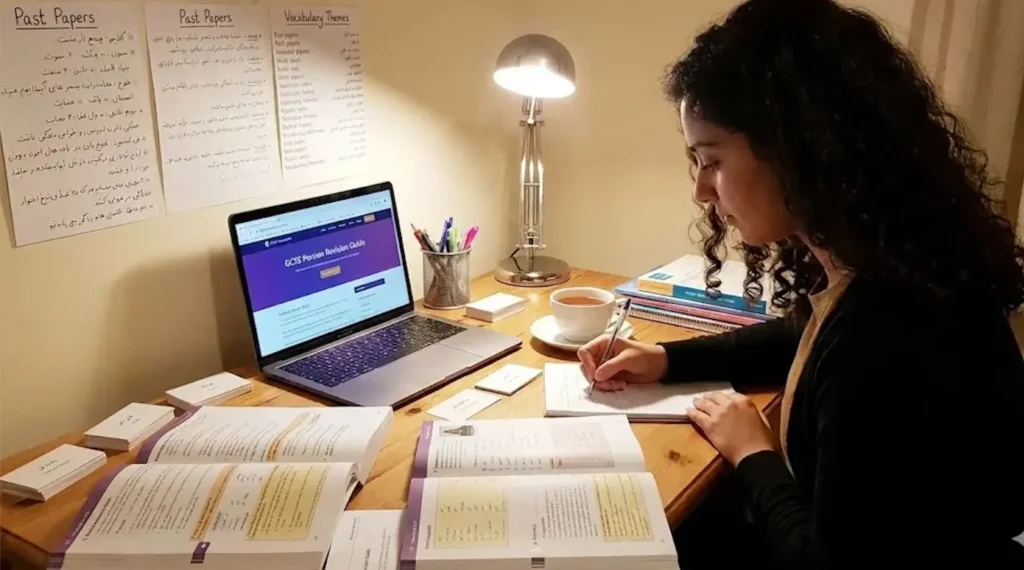
How to Prepare Effectively for GCSE Farsi (Persian) and A-Level Persian

Step 1: Diagnose the real starting point

Before building a plan, identify whether the student’s main gap is spelling, formal writing, speaking structure, reading speed, or translation accuracy. A targeted plan is always more efficient than “more practice.”

Step 2: Use the exam structure as the syllabus

The most effective preparation mirrors the exam: each week includes listening practice, speaking structure, reading comprehension, and writing + translation.

Step 3: Build a repeatable writing framework

Students should develop templates for opinion paragraphs: statement → reason → example → contrast → conclusion. This is the fastest path to higher marks.

Step 4: Practise with past papers and mark schemes

Past papers are not “extra.” They are the core of exam preparation. Mark schemes show exactly how marks are awarded and what examiners expect.

Many families prefer structured support through GCSE Persian online courses or focused A-Level Persian preparation, especially when the goal is a top grade and consistent feedback is needed.


Frequently Asked Questions (FAQ)

Is GCSE Persian accepted by UK universities?

Yes. GCSE Persian is an officially recognised GCSE subject (depending on exam board/specification) and is accepted by UK universities as part of a student’s GCSE profile.

Can homeschool students take GCSE Persian?

Yes. Home-educated students can take GCSE Persian as private candidates through an approved exam centre.

Is GCSE Persian easy for native speakers?

Spoken fluency helps, but top grades require formal writing, accurate spelling, and strong exam technique—areas where many native speakers need focused practice.

What is the difference between GCSE and A-Level Persian?

GCSE focuses on core language skills (listening, speaking, reading, writing). A-Level requires a higher level of accuracy and more advanced writing and analysis.


Conclusion

GCSE Farsi (GCSE Persian) and A-Level Persian can be excellent qualifications for students who prepare in a structured, exam-aligned way. The biggest misconception is that being able to speak Persian is enough. In reality, high performance comes from formal writing skills, translation strategy, and consistent practice with examiner expectations.

Exam structure based on Pearson Edexcel GCSE Persian specification.

Leave a Reply

Your email address will not be published. Required fields are marked *

Articles You May Also Like

Find Your Perfect Teacher

Register NOW !

Your Submition was successful.

Thank you for filling out the form on the Danaa website. We appreciate your input!

Welcome to Your Journey

By clicking Become a Tutor or Start Learning, 

you agree to Danaa School Terms of Use and Privacy Policy.