GCSE Persian Exam Structure Explained (Edexcel)
If you are preparing for the Edexcel GCSE Persian exam, understanding the exam structure is one of the smartest steps you can take.
Many students (and parents) assume GCSE Persian is mainly about speaking Persian at home — but the exam is academic and highly structured.
In this guide, we break down the GCSE Persian exam into its four assessed skills — Listening, Speaking, Reading, and Writing —
and explain what each paper includes, what students typically find difficult, and how to prepare efficiently.
For a broader overview of GCSE Persian preparation and how courses are structured, see our
GCSE Persian course guide.
What Is the GCSE Persian Exam?
GCSE Persian (sometimes searched as GCSE Farsi) is a GCSE language qualification assessed through four equally weighted components.
Each component contributes 25% of the final grade, so balanced preparation matters.
The exam is not simply a test of conversational fluency. Examiners award marks for accuracy, structure, comprehension, and exam technique —
especially in writing and translation.
Overview of the Four Exam Papers
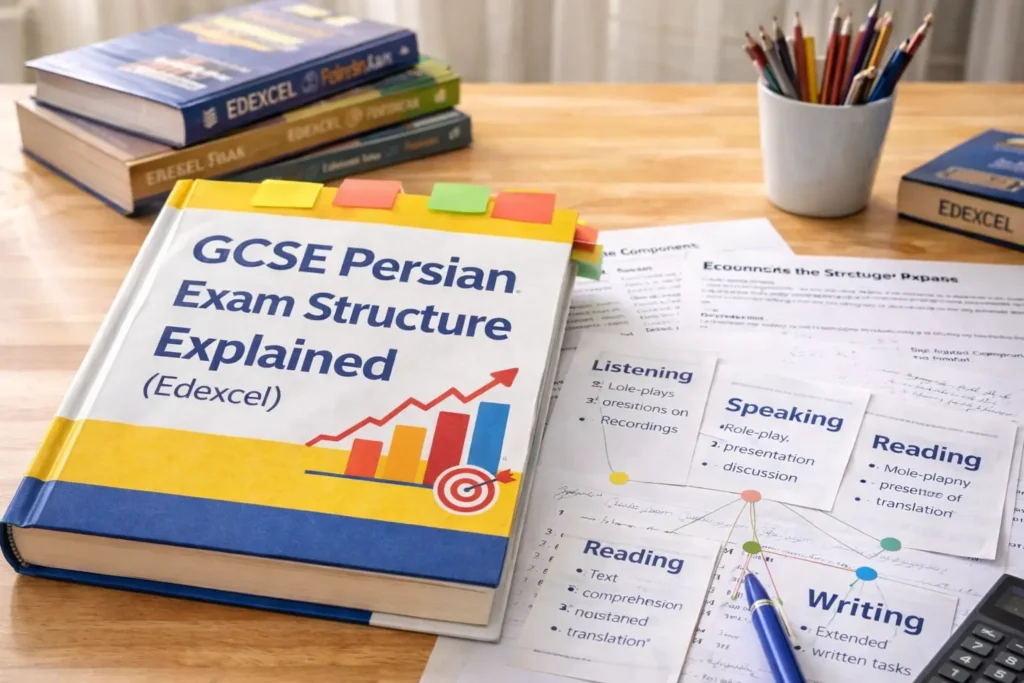
The Edexcel GCSE Persian exam assesses four skills:
- Listening (25%)
- Speaking (25%)
- Reading (25%)
- Writing (25%)
Students often perform well in speaking if they use Persian at home, but lose marks in writing and translation due to informal language,
spelling issues, and weak structure. The sections below explain exactly what to expect.
Listening Paper Explained
The listening paper tests your ability to understand spoken Persian across different contexts (everyday conversations, announcements, short talks,
and exam-style dialogues). Questions typically require you to identify key details, opinions, and specific information.
What students usually find difficult
- Fast pace and exam-style phrasing
- Missing negatives or small detail changes
- Numbers, dates, times, and places
- Understanding meaning when vocabulary is unfamiliar
How to prepare effectively
- Practise with exam-style recordings and timed questions
- Train yourself to listen for keywords and “signal phrases”
- Do quick note-taking for names, numbers, and locations
Speaking Paper Explained
The speaking assessment evaluates spoken communication, clarity, and how well a student can respond to questions with structured answers.
Students are expected to communicate confidently and extend answers where possible.
What students usually find difficult
- Answering in full sentences rather than short replies
- Using accurate verb tenses under pressure
- Organising responses (point, reason, example)
- Managing nerves and speaking at a steady pace
How to prepare effectively
- Memorise flexible “sentence starters” for common topics
- Practise role-play style answers with timing
- Record short answers and review for clarity and grammar
Reading Paper Explained
The reading paper assesses comprehension of Persian texts across different styles (short messages, emails, notices, simple articles, and more).
Students must demonstrate they can understand the main idea and extract specific details.
What students usually find difficult
- Unfamiliar formal vocabulary (especially for heritage speakers)
- Confusing similar words or meanings
- Rushing and missing detail questions
- Translation tasks (if included) requiring accuracy
How to prepare effectively
- Build an exam-topic vocabulary list and review it weekly
- Practise skimming for meaning, then scanning for details
- Use past-paper reading questions to train exam technique
Writing Paper Explained
Writing is often the most decisive part of GCSE Persian. Examiners look for accuracy, structured ideas, and appropriate formal Persian.
Even fluent speakers lose marks when they write informally or make spelling mistakes.
What students usually find difficult
- Spelling and correct written forms
- Using formal Persian instead of spoken Persian
- Organising paragraphs logically
- Translation accuracy (meaning over literal word order)
How to prepare effectively
- Practise writing short paragraphs first, then full tasks
- Use a checklist: tense, connectors, spelling, paragraph structure
- Get feedback on writing so mistakes do not repeat
How the Exam Is Marked (What Examiners Reward)
GCSE Persian marking is not only about “how much Persian you know”. Examiners typically reward:
- Accuracy: correct grammar, spelling, and sentence formation
- Range: variety of vocabulary and structures (not repetitive)
- Clarity: answers that directly address the question
- Structure: organised writing with logical sequencing
- Exam technique: responses that match the task type and mark scheme
Students who understand these criteria early usually make faster progress.
Common Mistakes Students Make
- Assuming speaking fluency guarantees a high grade
- Starting writing practice too late
- Using informal language in writing tasks
- Translating word-for-word instead of translating meaning
- Skipping past papers and mark schemes
Most of these mistakes are preventable once students understand what each paper expects.
How to Prepare Based on Exam Structure
A simple way to prepare is to build a weekly routine that covers all four skills:
- 1 session Listening: timed practice + review of mistakes
- 1 session Speaking: structured answers + topic vocabulary
- 1 session Reading: comprehension practice + vocabulary extraction
- 1 session Writing: paragraph practice + translation + feedback
If you want structured, exam-aligned support, you can explore our
GCSE Persian online courses.
Conclusion
The Edexcel GCSE Persian exam becomes much easier once students understand its structure.
Because each skill is worth 25%, balanced preparation is essential — especially for writing and translation.
If you are building your GCSE Persian plan, start by learning the format, practise with past papers, and focus on the areas where marks are most often lost.
For the broader preparation roadmap, return to our
GCSE Persian course guide.