
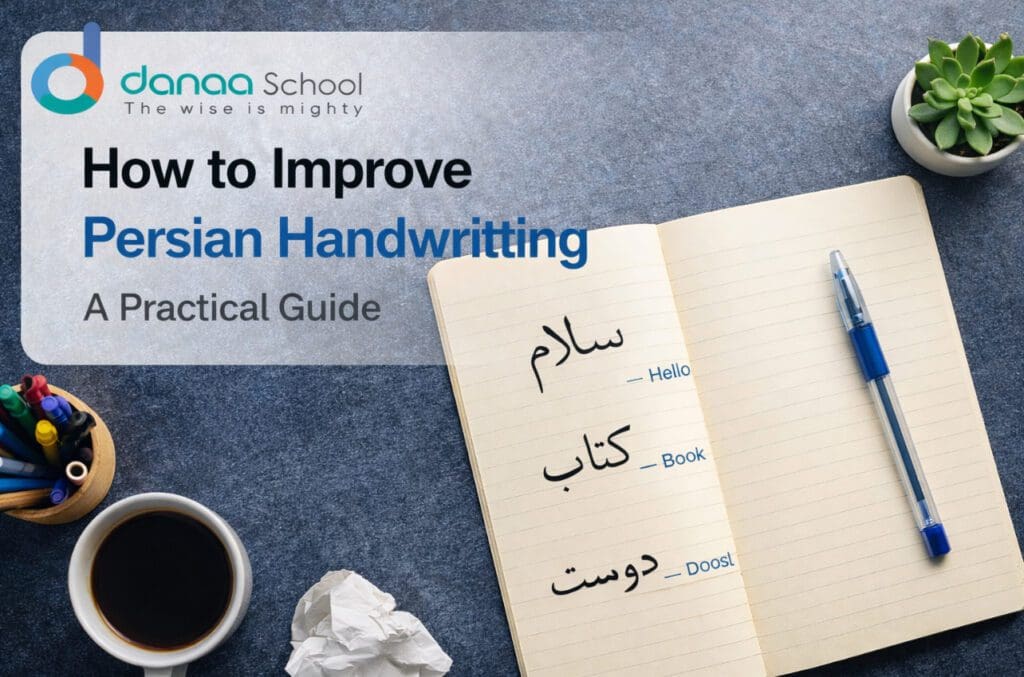
How to Improve Persian Handwriting: A Practical Guide
Persian handwriting is a beautiful blend of tradition, rhythm, and personal expression. Whether you are a native Persian speaker or learning Farsi as a second language, improving your Persian handwriting allows you to write more clearly, confidently, and naturally.
This practical guide explains how to improve Persian handwriting step by step, focusing on structure, consistency, and daily practice techniques that actually work.
Why Persian Handwriting Matters
Persian script is written from right to left and relies on smooth letter connections. Strong Persian handwriting helps learners:
- Write more clearly and avoid confusion
- Increase writing speed and fluency
- Improve spelling and memory through handwriting
With consistent practice, Persian handwriting becomes balanced, readable, and enjoyable.
Understand the Structure of Persian Letters
Each Persian letter has up to four forms depending on its position in a word. Understanding these forms is essential for improving Persian handwriting.
- Isolated, initial, medial, and final forms
- Common ligatures and connections
- Natural slant and flow of Persian writing
Tracing letters before writing them freely builds muscle memory and accuracy.
Use the Right Writing Tools
Using the right tools can significantly improve Persian handwriting quality.
- Gel pens for smooth letter connections
- Fine-tip pens for precision
- Lined or grid paper for alignment
Improve Hand Position and Posture
Proper hand position leads to smoother and more controlled handwriting.
- Hold the pen lightly
- Angle the paper slightly
- Allow free wrist movement
Practice Common Persian Words and Sentences
Practicing real Persian words helps handwriting improve faster than writing letters alone.
- سلام – Hello
- کتاب – Book
- دوست – Friend
Move gradually to full sentences while focusing on spacing and consistency.
Common Persian Handwriting Mistakes
Recognizing common mistakes helps you improve Persian handwriting faster.
- Uneven letter size → use lined paper
- Poor spacing → slow down writing
- Weak connections → practice ligatures
- Wavy baseline → focus on alignment
How Persian Handwriting Supports Language Learning
Practicing Persian handwriting improves spelling, reading accuracy, and vocabulary retention. Writing by hand strengthens the connection between sound, form, and meaning.
For learners who learn Farsi, handwriting accelerates reading fluency and boosts confidence.
To better understand Persian script, you can also explore the Persian alphabet.
Create a Daily Persian Handwriting Routine
Short daily practice sessions are the most effective way to improve Persian handwriting.
- Practice 10–15 minutes daily
- Keep a handwriting notebook
- Review progress weekly
FAQs
How long does it take to improve Persian handwriting?
With daily practice, improvement appears within a few weeks.
Is Persian calligraphy necessary?
No, but it can refine letter shape and flow.
Learn Persian Writing with Danaa School
At Danaa School, students improve Persian handwriting through structured lessons focused on real-world reading and writing. Our courses help learners write Persian with clarity and confidence.