Persian Music and Instruments Vocabulary
Persian music is one of the richest and most enchanting art forms in the world.
Learning Persian music and instruments vocabulary helps language learners,
music lovers, and cultural explorers understand Iranian traditions more deeply.
In this guide, we explore essential Persian music terms, traditional instruments,
and musical genres used in Iranian culture.
The Importance of Persian Music Vocabulary in Culture
Music has played a vital role in Persian history, from ancient rituals to modern compositions.
Understanding Persian music and instruments vocabulary allows learners to connect music with
Persian poetry, storytelling, and spirituality.
Persian classical music follows a system known as
Dastgah,
which defines melodic structures and improvisation.
This musical system is deeply tied to emotional expression and cultural identity.
Common Persian Music and Instruments Vocabulary
Below are essential Persian music vocabulary terms commonly used when discussing Iranian music:
- موسیقی (Musiqi) – Music
- ساز (Saz) – Musical instrument
- آهنگ (Ahang) – Song or melody
- نوازنده (Navazandeh) – Musician
- خواننده (Khanandeh) – Singer
- ریتم (Ritm) – Rhythm
- شور (Shur) – A traditional Dastgah
Mastering Persian music and instruments vocabulary makes it easier to understand song lyrics,
musical discussions, and cultural references.
Persian Music Instruments Vocabulary
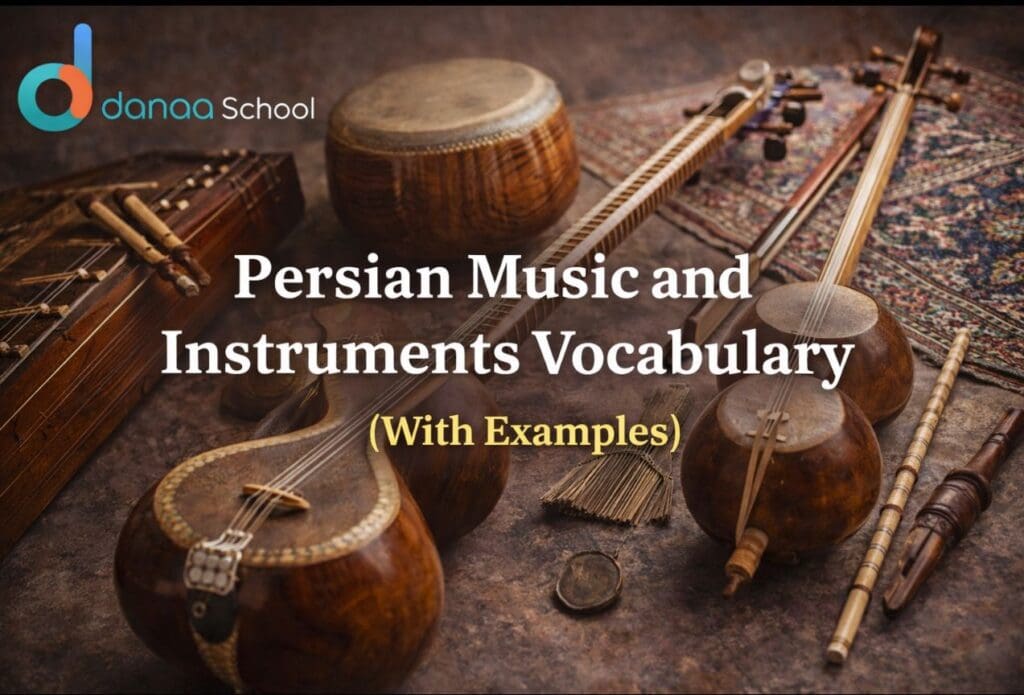
Persian music uses a variety of traditional instruments, each with a distinct sound and role.
Here are the most important ones:
Tar (تار)
The Tar is a long-necked string instrument and one of the most iconic sounds in Persian classical music.
Setar (سهتار)
The Setar is a softer string instrument often used for intimate and spiritual performances.
Santur (سانتور)
A hammered string instrument played with wooden mallets, producing bright melodic tones.
Tombak (تنبک)
The Tombak is the primary Persian drum, providing rhythm and structure.
Kamancheh (کمانچه)
A bowed string instrument known for its emotional and expressive sound.
Ney (نی)
A reed flute closely associated with Sufi and mystical Persian music.
Popular Persian Music Genres
Understanding Persian music genres helps expand your Persian music and instruments vocabulary:
- Classical Persian Music – Based on Dastgah and poetry
- Folk Music – Regional and traditional styles
- Persian Pop – Modern music blending traditional and global sounds
- Sufi Music – Spiritual and mystical compositions
- Fusion & Rock – Contemporary experimental styles
How to Improve Persian Music Vocabulary
- Listen to Persian music daily
- Read song lyrics with translations
- Watch interviews with Persian musicians
- Practice vocabulary using flashcards
Learn Farsi with Danaa School
If you want to master Persian music and instruments vocabulary while learning the language,
join Danaa School.
Our expert teachers help you learn Farsi through culture, music, and real communication.
FAQs
- What is Persian music called?
Musiqi-ye Sonnati or Musiqi-ye Iran. - What is the most famous Persian instrument?
The Tar. - What is the Persian word for music?
Musiqi (موسیقی). - What is a Persian drum called?
Tombak (تنبک). - How can I learn Persian music vocabulary faster?
By listening to music, reading lyrics, and practicing regularly.
Conclusion
Persian music reflects centuries of culture, poetry, and emotion.
By learning Persian music and instruments vocabulary, you strengthen both your language skills
and cultural understanding, making your connection to Persian culture deeper and more meaningful.