Planets and Space Vocabulary in Persian: A Complete Guide for Learners
The universe has always inspired human curiosity, and for centuries Persian scholars, poets, and scientists have explored the mysteries of the sky. Learning Planets and Space Vocabulary in Persian is not only useful for language learners but also offers insight into Persian culture, science, and literature. This guide provides a clear and practical overview of space-related terms in Persian (Farsi), from planets to astronomy and space exploration.
Planets and Space Vocabulary in Persian: The Solar System
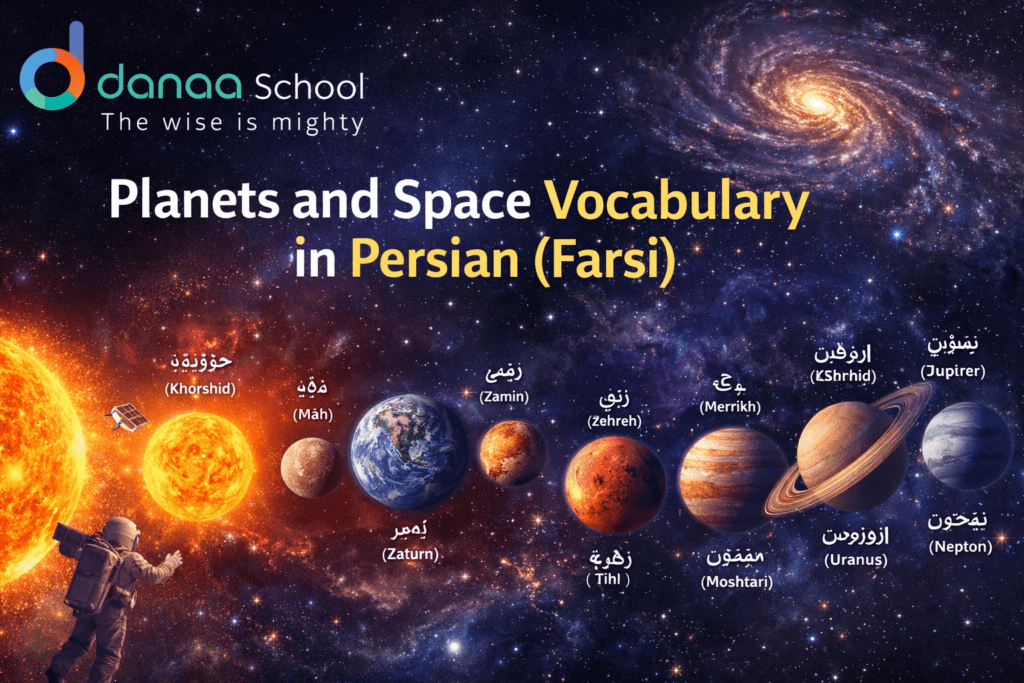
In Persian, the solar system is called منظومه شمسی (Manzumeh-ye Shamsi). It includes the Sun, planets, moons, and other celestial objects. Below are the most commonly used planetary names in Persian:
- Sun – خورشید (Khorshid)
- Moon – ماه (Māh)
- Earth – زمین (Zamin)
- Mercury – تیر (Tir)
- Venus – زهره (Zohreh)
- Mars – مریخ (Merrikh)
- Jupiter – مشتری (Moshtari)
- Saturn – زحل (Zohal)
- Uranus – اورانوس (Uranus)
- Neptune – نپتون (Nepton)
These words are used in scientific contexts, educational materials, and even everyday conversations when discussing astronomy in Persian.
Essential Planets and Space Vocabulary in Persian
To talk confidently about space, you need more than just planet names. Here are essential space and astronomy terms in Persian:
- Universe – جهان (Jahān)
- Space – فضا (Fazā)
- Galaxy – کهکشان (Kahkeshān)
- Milky Way – راه شیری (Rāh-e Shirī)
- Star – ستاره (Setāreh)
- Black Hole – سیاهچاله (Siyāh-Chāleh)
- Asteroid – سیارک (Sayyārak)
- Comet – دنبالهدار (Donbāleh-dār)
- Orbit – مدار (Madār)
- Gravity – جاذبه (Jāzebeh)
Understanding this Planets and Space Vocabulary in Persian helps learners read science texts and understand media discussions about space.
Talking About Space Exploration in Persian
Modern Persian includes many terms related to space missions and technology. These words are frequently used in news and educational content:
- Astronaut – فضانورد (Fazānavard)
- Satellite – ماهواره (Māhvāreh)
- Spaceship – سفینه فضایی (Safineh-ye Fazāyi)
- Space Station – ایستگاه فضایی (Istgāh-e Fazāyi)
- Telescope – تلسکوپ (Teleskop)
Using correct Planets and Space Vocabulary in Persian allows learners to discuss space exploration naturally and accurately.
Persian Scholars and Astronomy
Persian culture has a deep connection with astronomy. Renowned scholars such as Omar Khayyam, Al-Biruni, and Nasir al-Din Tusi made groundbreaking contributions to planetary motion, calendars, and mathematical astronomy. Their legacy still influences how astronomy is studied today.
This historical background explains why space-related vocabulary appears frequently in Persian literature and poetry.
Why Learn Planets and Space Vocabulary in Persian?
Learning Planets and Space Vocabulary in Persian offers several advantages:
- Expands scientific and academic vocabulary
- Helps understand Persian poetry and metaphors
- Improves comprehension of news and documentaries
- Enables deeper cultural and historical understanding
Many Persian poems reference stars, planets, and the universe as symbols of destiny, love, and wisdom.
Learn Persian with Danaa School
If you want to master Persian vocabulary in a structured and engaging way, Danaa School offers professional Persian language courses. Our lessons combine language, culture, and practical usage to help learners gain confidence quickly.
From everyday vocabulary to advanced topics like science and literature, Danaa School supports learners at every level.
Conclusion
Understanding Planets and Space Vocabulary in Persian connects language learning with science, history, and culture. Whether you are fascinated by astronomy or simply want to expand your Persian vocabulary, these terms will help you communicate more fluently and confidently. Keep exploring the universe—both in space and in language.