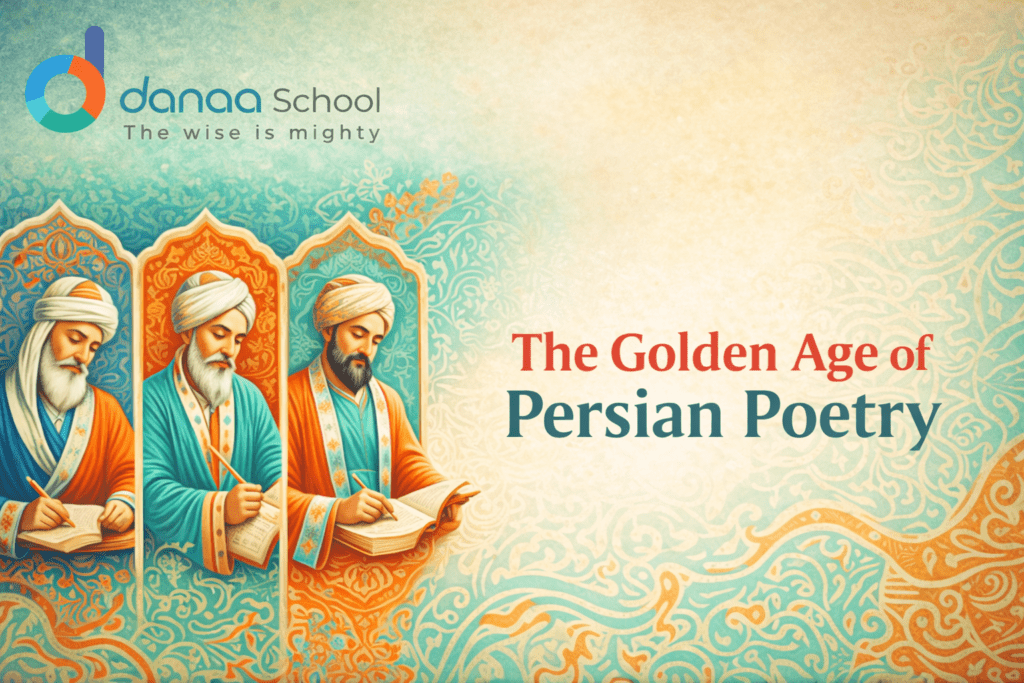
The Golden Age of Persian Poetry
The Golden Age of Persian Poetry represents one of the most influential and enduring literary movements in world history. Spanning roughly from the 9th to the 14th century, this remarkable period produced poets whose works continue to shape literature, spirituality, philosophy, and cultural identity across continents.
During this era, Persian poetry became a powerful medium for expressing love, mysticism, ethics, and the human experience, bridging ancient Persian traditions with the intellectual and spiritual currents of the Islamic world.
Historical Background of Persian Poetry
Persian poetry evolved over centuries, drawing inspiration from pre-Islamic Iranian heritage and later incorporating Islamic philosophy, Arabic literary forms, and Sufi spirituality. This fusion created a rich and flexible poetic language capable of conveying deep emotion, wisdom, and transcendence.
Pre-Islamic Foundations
Before the rise of Islam, Persian literary culture thrived through oral storytelling, epic narratives, and court poetry during the Achaemenid and Sassanian eras. These traditions preserved mythology, heroic ideals, and moral values that later culminated in Ferdowsi’s monumental epic, the Shahnameh, which safeguarded the Persian language for future generations.
The Islamic Period and Literary Flourishing
With the spread of Islam, Persian poetry absorbed new intellectual and spiritual influences while maintaining its linguistic identity. Persian soon became the primary language of poetry, culture, and scholarship across a vast region stretching from Central Asia to Anatolia and South Asia.
Key Poets of the Golden Age
Rumi
Jalal ad-Din Rumi is one of the most widely read poets in human history. His masterpieces, including the Masnavi and Divan-e Shams, explore divine love, spiritual transformation, and the soul’s journey toward unity. Rumi’s poetry transcends religious and cultural boundaries, making his voice universally relevant even today.
Hafez
Hafez perfected the ghazal form, blending lyrical beauty with philosophical and spiritual depth. His poetry explores love, freedom, truth, and hypocrisy through multilayered symbolism. Hafez remains deeply woven into Persian daily life, often consulted for reflection, guidance, and inspiration.
Saadi
Saadi’s works, the Gulistan and Bustan, combine storytelling with ethical and social wisdom. His human-centered worldview emphasizes compassion, humility, justice, and responsibility toward others. Saadi’s teachings continue to resonate across cultures and generations.
Major Themes in Persian Poetry
Despite stylistic differences, poets of the Golden Age shared recurring themes that define the soul of Persian poetry.
- Mysticism and Sufism: Poetry as a path toward spiritual awakening and divine union.
- Love: Earthly and divine love as forces of transformation.
- Nature: Gardens, wine, birds, and seasons as metaphors for inner states.
- Ethics and Wisdom: Guidance on morality, humility, and human conduct.
Poetic Forms and Styles
Persian poets mastered a range of poetic forms, each suited to specific themes and expressions.
- Ghazal: Lyrical poems centered on love, longing, and spiritual desire.
- Masnavi: Narrative verse used for storytelling and spiritual instruction.
- Qasida: Formal odes often composed in praise of patrons, rulers, or ideals.
Cultural and Global Influence
The Golden Age of Persian Poetry profoundly shaped literature across the Islamic world and later influenced European writers, philosophers, and artists. Through translation, poets such as Rumi, Hafez, and Saadi introduced Persian literary thought to global audiences, reinforcing poetry as a universal language of wisdom and connection.
Why Study Persian Poetry at Danaa School?
Danaa School offers structured courses in Persian language and literature, enabling students to explore the Golden Age through original texts and guided interpretation. Our programs combine cultural context, language learning, and literary analysis to create a meaningful and immersive experience.
Whether you are a beginner or an advanced learner, Danaa School provides a supportive environment to discover the beauty, philosophy, and lasting relevance of Persian poetry.
Conclusion
The Golden Age of Persian Poetry stands as a pinnacle of human creativity, where language became a vessel for love, wisdom, and spiritual insight. Through the timeless voices of Rumi, Hafez, Saadi, and others, this literary tradition continues to inspire readers to seek meaning beyond time, borders, and cultures.
FAQs
- When was the Golden Age of Persian Poetry? Approximately from the 9th to the 14th century.
- Who are the most important poets of this era? Rumi, Hafez, Saadi, Ferdowsi, and Attar.
- Why is Persian poetry still relevant today? Its universal themes of love, spirituality, ethics, and humanity remain timeless.
- Is Persian poetry accessible in translation? Yes, though learning Persian reveals deeper layers of meaning and beauty.